
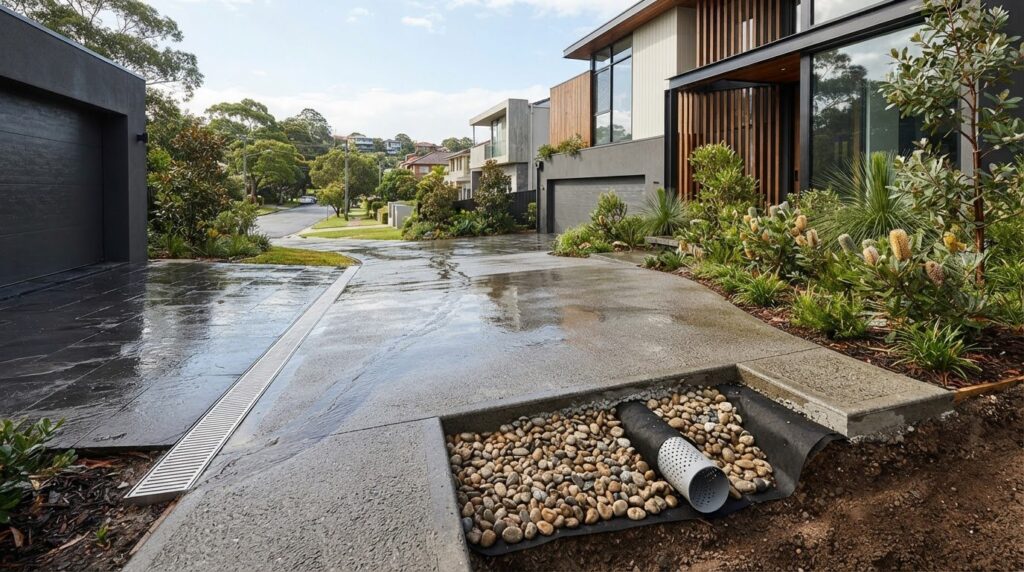
A driveway that holds water usually needs its fall corrected or a drainage point added where runoff collects. To understand how to improve driveway drainage, first identify whether water is pooling on the surface or moving through the ground: a channel drain can capture fast surface runoff, while a French drain can intercept subsurface water. On gravel, a slope of around 1-1.5% can help water run off rather than gather in low spots.
It’s frustrating when puddles linger after rain, especially if they start to erode the driveway or affect nearby areas. The right fix depends on where the water comes from, the driveway surface and where runoff can be directed.
This guide covers common causes of driveway drainage problems, how French drains work and how drainage systems differ. Learn what to consider about excavation, materials, water flow, outlets and maintenance so you can identify an approach suited to your property. A low-cost fix may not be the most durable solution.
Key Takeaways
- Trace where runoff comes from before choosing a fix; surface pooling and subsurface seepage call for different drainage approaches.
- A French drain can intercept water moving beneath or alongside a gravel driveway, but its outlet and the ground conditions matter.
- Positioning a channel drain at the driveway’s low point helps capture surface water where it gathers fastest.
- Compare systems by more than installation cost: excavation, drainage capacity, discharge options and cleaning needs all affect long-term suitability.
French drains for gravel driveways
A French drain collects subsurface water before it softens a gravel driveway’s base. It consists of a gravel-filled trench and a perforated pipe that carries excess water to a suitable outlet. Beneath gravel, a land drain or twinwall pipe can intercept water flowing from a higher lawn, garden border or neighbouring level. The outlet is essential: without a suitable discharge point, collected water has nowhere to go.
Use a French drain for water moving through soil, not as the first solution to persistent surface puddles. A trench drain, also called a channel drain, sits at the surface and captures runoff flowing across paving. A threshold drain is positioned across a doorway or garage entrance to help prevent water entering. These systems handle different flow paths: French drains intercept subsurface water, while threshold and trench drains collect surface runoff.
For gravel that pools, a fall of around 1-1.5% can help surface water run off. The fall should guide rain away from buildings towards an appropriate collection point. Australian council requirements and stormwater connection rules can vary by location and proposed discharge route. Keep runoff on the property rather than assuming it can flow onto a street, pavement or neighbouring land.
Clay soil affects how collected water disperses. A soakaway may drain too slowly in dense clay or very wet ground, so a French drain needs an outlet suited to the site. On a sloping block, a shallow U-shaped swale can direct water away from the driveway or house. Natural drainage designs can also use vegetated contours to guide runoff while treating it as it moves through the property.
Runoff directed onto a neighbour’s property or the street can erode soil, affect landscaping and create water-management problems beyond the driveway. Keep the discharge route within your property and away from buildings. If water continues to pool beside cracks, trace where it enters, where it collects and whether the outlet carries it away.
What causes drainage problems?
Standing water often points to a low spot, restricted flow or runoff entering from elsewhere. On paved and concrete driveways, tracing the water’s source helps distinguish a surface issue from a problem beneath the existing base. A practical first step in how to improve driveway drainage is to observe where water arrives and where it remains after rain.
Sources of Driveway Puddles
A driveway puddle forms when water reaches a depression or cannot flow to a collection point. During rainfall, note where water first appears, where it gathers and whether a downpipe discharges onto the driveway. Raised garden edging, turf or flowerbeds can trap runoff against paving and send it towards the house. These clues help you address the cause, not just the visible puddle.
Assess the fall by watching rainwater move across the surface, then compare its path with driveway edges and nearby buildings. A driveway slope of around 1-1.5% can help direct surface water away from a house. On concrete, look for depressions, cracks and sunken sections; on block paving, check for rocking units that may signal movement below. A larger paved area may collect more runoff, especially when a downpipe adds roof water.
In heavy Australian rain, match the collection system to the flow: channel drains capture surface runoff, while a suitable outlet carries it away. The right arrangement depends on the driveway’s fall, incoming water and where discharge can be managed. To improve driveway drainage, identify these site conditions before choosing a solution.
Rainfall and Drainage Damage
Excess rainwater overwhelms a driveway when its surface, low points or existing drainage cannot move runoff away fast enough. Leaves, soil, moss and gravel can restrict channel drains and gullies, while a blocked or poorly placed outlet leaves water sitting on concrete or paving. Clear debris first, then assess whether the drainage system is also inadequate.
Persistent pooling can create a slip hazard and weaken the driveway foundation, contributing to cracks and potholes. Runoff at the edges can erode ground and threaten landscaping; water reaching the house can cause moisture problems in lower levels. Trace roof downpipes, sloping ground and driveway runoff together to identify what needs managing.
Council requirements and stormwater connection rules can vary by location and discharge route. Before changing a connection or directing runoff beyond your property, establish the applicable local requirements and plan for a suitable outlet.
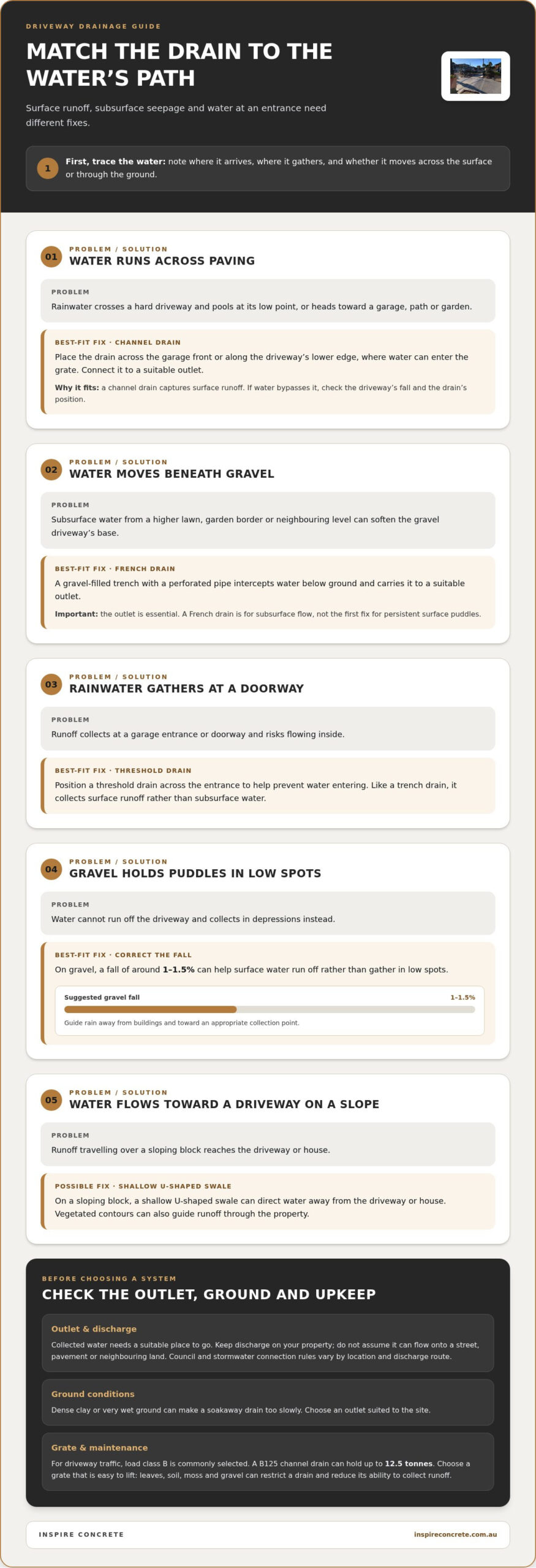
Firstly, why is there water on my driveway?
Water often collects where the driveway’s fall ends or the surface dips. A channel drain at that low point intercepts surface water before it spreads towards a garage, path or garden. It’s most useful where runoff gathers quickly across a hard, impermeable surface, rather than soaking through the driveway.
Position the channel across the garage front or along the driveway’s lower edge, where moving water can enter the grate. Connect the drain to a suitable pipe, sewer or other drainage system. A channel drain can capture runoff across a wide area, but the collection point and outlet must work together. If water bypasses the grate, check the driveway’s fall and the drain’s position.
Choose a grate designed for the traffic crossing it. Load class B is commonly selected for driveways and suits vehicle areas. A B125 channel drain can hold up to 12.5 tonnes. The grate should also be easy to lift for cleaning, because leaves, soil, moss and gravel can restrict the channel. A blocked drain cannot collect runoff effectively.
Surface drainage combines the driveway’s fall, channel and collection point to guide rainwater across an impermeable surface and into an outlet. French drains work differently: they collect water below ground through a gravel-filled trench and perforated pipe. They suit subsurface flow, while channel drains suit fast-moving surface water. Choose between them by identifying where the water travels.
Installation must preserve the driveway’s structural support and direct collected water appropriately. Position the channel at the actual low point, with the grate aligned to the surrounding surface so runoff can enter. If the grate sits too high, water may pass around it; if the surrounding edge sinks, pooling can continue. Persistent water near cracks or potholes may indicate a wider problem with the base or fall, not just drain placement. Repairing the visible surface alone won’t fix a drainage route that still sends water to the same low spot.
Comparing drainage system costs, installation, and maintenance
Compare systems by the water they collect, the surrounding ground and the work installation requires. A channel or trench drain captures surface runoff through a grated channel, then carries it to a suitable outlet. A soakwell collects water and releases it gradually into surrounding soil. A French drain intercepts subsurface flow through a gravel-filled trench and perforated pipe. Each system addresses a different drainage problem.
For an impermeable concrete driveway, a channel drain suits rapid surface flow, but installation involves creating a channel and connecting its outlet. A soakwell avoids a direct stormwater connection where one isn’t possible, though dense clay or saturated ground can slow dispersal. A French drain requires a trench and an outlet for collected water. A culvert needs excavation beneath the driveway, and its type and size depend on the property’s drainage needs.
Installation cost depends on excavation, materials, access, driveway repairs and the outlet route. The project price is set after a quote request. For example, adding a channel across an existing driveway involves different work from installing a culvert beneath it. Rebuilding a settled section may also require investigating the failed base, rather than laying new surface material over the same problem.
Maintenance affects how reliably each drainage system works. Clear leaves, soil, moss and gravel from channel grates and gullies so water can enter freely. Lift grates designed for cleaning and remove debris from the channel. Check soakwell inlets for blockages, and look for renewed pooling around the surrounding surface after rain. For French drains, watch for signs that water isn’t reaching its intended outlet.
To compare options, match the system to the water source, ground conditions, installation disruption, outlet and cleaning access. That gives a clearer basis for weighing upfront work against upkeep. If a concrete driveway upgrade is part of the project, explore concrete driveway finishes alongside your drainage planning.
Inspire Concrete: Exposed Aggregate Driveways
Inspire Concrete builds Exposed Aggregate Driveways for property owners planning a refined, durable concrete surface. If drainage issues have led you to replace or redesign a driveway, consider the surface finish alongside its fall and water collection plan. Drainage depends on the driveway’s layout and suitable water paths, not appearance alone.
For a different look, Inspire Concrete also builds Stencil Concrete Driveways, Stamped Concrete Driveways and Coloured Concrete Driveways. These finishes shape the driveway’s visual character, while the design should also consider how the surface meets the home and surrounding areas. Discuss your preferred design when planning a concrete upgrade.
Contact Inspire Concrete or visit inspireconcrete.com.au to discuss your driveway project.
Plan a driveway that works as a whole
Include drainage in the driveway plan, rather than treating it only after water appears. Before changing the surface, map where rain arrives, where it flows and where it can be collected safely. This gives the finished design a clear purpose and helps align its appearance with the practical needs of your property.
Planning how to improve driveway drainage also means considering how the surface meets the garage, pathways and garden edges. A coordinated project considers these transitions together rather than treating each area as a separate fix. If you’re planning a new concrete driveway or redesign, Inspire Concrete can help shape the surface around your property’s intended layout.
Explore a driveway project with Inspire Concrete and take the next step towards a more considered, functional finish.
Frequently Asked Questions
What are the common causes of poor driveway drainage?
Common causes include roof runoff entering at one point, a blocked inlet or a surface that holds water after rain. The timing and shape of a puddle offer useful clues: water appearing during rainfall near a downpipe suggests incoming runoff, while a puddle that remains after surrounding areas dry may indicate a local low spot. In Sydney, observe your driveway during and after rain to trace the source.
How do you install a driveway channel drain step by step?
Plan the channel drain route to collect runoff and lead it to a suitable outlet. Installation generally follows this sequence:
- Mark the collection line and identify the outlet.
- Excavate the channel trench across the runoff path.
- Set the drain level with the driveway and connect its outlet.
- Secure the grate, restore the edges and test water flow.
Correct alignment helps prevent surface water bypassing the channel.
How much does driveway drainage installation cost in Australia?
The price depends on the site, so there’s no single figure for every Australian driveway. Key cost factors include the drain type and length, excavation difficulty, existing concrete or paving to remove, machinery access, outlet connection and reinstatement. A short channel beside an open gravel drive involves different work from cutting through an existing concrete driveway in Sydney.
